
Human Capital vs Token Capital: Why Satya Nadella Believes This Will Define AI Winners
For years, companies competed by hiring the best talent, building stronger brands, and investing in technology. Today, a new asset class is emerging—one that doesn't sit on a balance sheet but may become more valuable than software, intellectual property, or even customer databases.
Microsoft CEO Satya Nadella recently introduced a framework that captures this shift: Human Capital and Token Capital.
The concept is deceptively simple.
The companies that win in the AI era will not be those with the most AI tools. They will be the organizations that successfully combine human expertise with AI systems that continuously learn from that expertise and preserve it over time.
This distinction could determine which businesses compound knowledge for decades and which ones repeatedly start over every time key employees leave.
The Traditional Asset: Human Capital
Human Capital has long been the foundation of successful organizations.
It includes:
- Expertise
- Experience
- Judgment
- Creativity
- Leadership
- Relationships
- Problem-solving ability
A great marketer, software architect, consultant, salesperson, or executive represents Human Capital because they possess knowledge that creates value.
For decades, businesses focused heavily on acquiring and retaining talented people because knowledge primarily lived inside employees' minds.
The challenge is obvious.
When knowledge remains undocumented, companies become dependent on individuals.
When employees leave, institutional memory often leaves with them.
Many organizations have experienced this firsthand:
- Lost client relationships
- Missing project context
- Inconsistent processes
- Repeated mistakes
- Long onboarding cycles
Human Capital remains essential, but by itself it has limitations.
Enter Token Capital
Nadella describes Token Capital as the AI-era counterpart to Human Capital.
If Human Capital is what people know, Token Capital is what the organization's AI systems know.
Token Capital is created when a company transforms expertise into AI-readable knowledge.
This includes:
- SOPs
- Internal documentation
- Project histories
- Customer interactions
- Case studies
- Sales conversations
- Product decisions
- Training materials
- Code repositories
- Marketing campaigns
Instead of knowledge being trapped inside employees' heads, it becomes part of a continuously expanding organizational intelligence layer.
The result is a company that remembers.
Not through individuals.
But through systems.
Why AI Changes the Economics of Knowledge
Historically, documenting knowledge was useful but often underutilized.
Employees rarely searched hundreds of documents before making decisions.
AI changes that equation.
Modern AI systems can:
✅ Search thousands of documents instantly
✅ Identify patterns across years of work
✅ Generate recommendations using historical context
✅ Accelerate employee onboarding
✅ Surface best practices automatically
This transforms documentation from a passive archive into an active business asset.
What was previously stored information becomes operational intelligence.
That intelligence is Token Capital.
The Compounding Effect
The most powerful aspect of Nadella's framework is the idea of compounding.
Knowledge no longer grows linearly.
It grows through a feedback loop.
Step 1: Humans Create Knowledge
Employees solve problems.
They build strategies.
They interact with customers.
They discover what works.
Step 2: Knowledge Is Captured
Processes are documented.
Projects are archived.
Customer insights are recorded.
Decisions are explained.
Step 3: AI Learns From It
AI systems gain access to organizational context.
They understand patterns and outcomes.
Step 4: Humans Learn Faster
Employees receive better recommendations.
New hires become productive more quickly.
Teams avoid repeating mistakes.
Step 5: More Knowledge Is Created
The cycle continues.
Each iteration increases both Human Capital and Token Capital simultaneously.
Why AI Tools Alone Are Not a Competitive Advantage
Many businesses assume adopting AI tools automatically creates an advantage.
That assumption is increasingly flawed.
Every competitor can access:
- ChatGPT
- Copilot
- Claude
- Gemini
- Open-source models
The technology itself is becoming accessible to everyone.
The differentiator is not the model.
The differentiator is the knowledge connected to the model.
A generic AI system can answer generic questions.
An AI system connected to years of organizational expertise can provide insights competitors cannot replicate.
This is why Nadella argues that future value will come from company-specific learning systems rather than frontier AI models alone.
A Marketing Agency Example
Imagine two agencies.
Agency A
- 20 experienced marketers
- Minimal documentation
- Knowledge lives inside employees
When senior staff leave, expertise disappears.
Agency B
- 20 experienced marketers
- Every campaign documented
- Every SEO audit archived
- Every client lesson captured
- AI connected to all historical knowledge
A new employee can instantly access years of expertise.
The organization retains institutional memory regardless of staff turnover.
Over time, Agency B develops significantly more Token Capital.
The gap widens every year.
The Emerging AI-Era Balance Sheet
Nadella's framework suggests future company value may increasingly depend on four assets:
| Asset | Description | Strategic Value |
|---|---|---|
| Human Capital | Expertise, judgment, creativity | Innovation and decision-making |
| Token Capital | AI-accessible organizational knowledge | Scalability and retention |
| Proprietary Data | Unique business information | Competitive differentiation |
| AI Workflows | Automated execution systems | Productivity and efficiency |
Companies that build all four create sustainable advantages that competitors struggle to replicate.
The Data Behind the Knowledge Economy
📊 The growing importance of organizational knowledge is supported by broader workforce and AI trends.
| Metric | Value | Year | Source |
| Global knowledge workers | Over 1 billion | 2025 | World Economic Forum |
| Organizations using AI in at least one business function | 78% | 2025 | McKinsey Global Survey |
| Executives expecting AI to reshape business models | 65%+ | 2025 | Gartner |
| Fortune 500 market value tied to intangible assets | Approximately 90% | 2025 | Ocean Tomo / Intangible Asset Market Value Study |
These numbers highlight a clear reality:
Competitive advantage increasingly comes from knowledge, systems, and intellectual assets rather than physical infrastructure.
Token Capital may become one of the most important intangible assets companies own.
What This Means for SaaS Companies
For SaaS businesses, Token Capital extends beyond internal operations.
Every interaction becomes a learning opportunity:
- Customer support tickets
- Product feedback
- User behavior
- Feature adoption patterns
- Churn reasons
Companies that transform these signals into AI-accessible knowledge can create products that improve continuously.
This creates a reinforcing cycle where customers indirectly help train the organization's intelligence layer.
What This Means for Service Businesses
Consultancies, agencies, and professional services firms are especially positioned to benefit.
Historically, these businesses relied heavily on Human Capital.
Their greatest risk was losing expertise when employees departed.
Token Capital changes that dynamic.
Instead of selling only human expertise, firms can build systems that preserve and amplify expertise.
This improves:
- Consistency
- Scalability
- Profitability
- Client outcomes
The result is a business that becomes smarter over time.
The Future Belongs to Companies That Learn
One of Nadella's most important observations is that Human Capital does not become less valuable as Token Capital grows.
It becomes more valuable.
AI without human judgment creates noise.
Human expertise without scalable systems creates bottlenecks.
The real opportunity emerges when both work together.
Organizations that build this learning loop effectively create an asset that compounds year after year.
Not just software.
Not just data.
But organizational intelligence itself.
As AI becomes increasingly accessible, the companies that stand apart will not necessarily have the best models.
They will have the best memory.
FAQs
What is Human Capital?
Human Capital refers to the knowledge, expertise, skills, judgment, creativity, and experience possessed by employees and leaders within an organization.
What is Token Capital?
Token Capital refers to AI-accessible organizational knowledge created from documents, workflows, data, interactions, and expertise that AI systems can learn from and utilize.
Why is Token Capital important?
Token Capital allows companies to preserve institutional knowledge, improve productivity, accelerate onboarding, and create competitive advantages that remain even when employees leave.
Does Token Capital replace Human Capital?
No. Human Capital creates the expertise that Token Capital captures. The two are complementary and become more valuable when combined.
How can businesses start building Token Capital?
Organizations can begin by documenting processes, centralizing knowledge, preserving project histories, organizing customer insights, and connecting AI systems to these information sources.
Which industries benefit most from Token Capital?
Knowledge-intensive industries such as SaaS, consulting, marketing, legal services, healthcare, finance, and software development stand to benefit the most.
Is Token Capital only relevant for large enterprises?
No. Small and mid-sized businesses can often build Token Capital faster because they have fewer systems, less complexity, and quicker decision-making processes.
Service pages connected to this article
These pages help readers move from education into implementation and strengthen internal relevance signals across the site.
Search Engine Optimization Services in Pakistan for businesses that need better keyword targeting across commercial, local, and supporting informational terms and a clearer path from execution to measurable growth.
Open ServiceGraceSol ServiceSEO Services in DubaiSEO Services in Dubai for businesses that need better keyword targeting across commercial, local, and supporting informational terms and a clearer path from execution to measurable growth.
Open ServiceGraceSol ServiceSEO Services in LondonSEO Services in London for businesses that need better keyword targeting across commercial, local, and supporting informational terms and a clearer path from execution to measurable growth.
Open ServiceRelated Stories
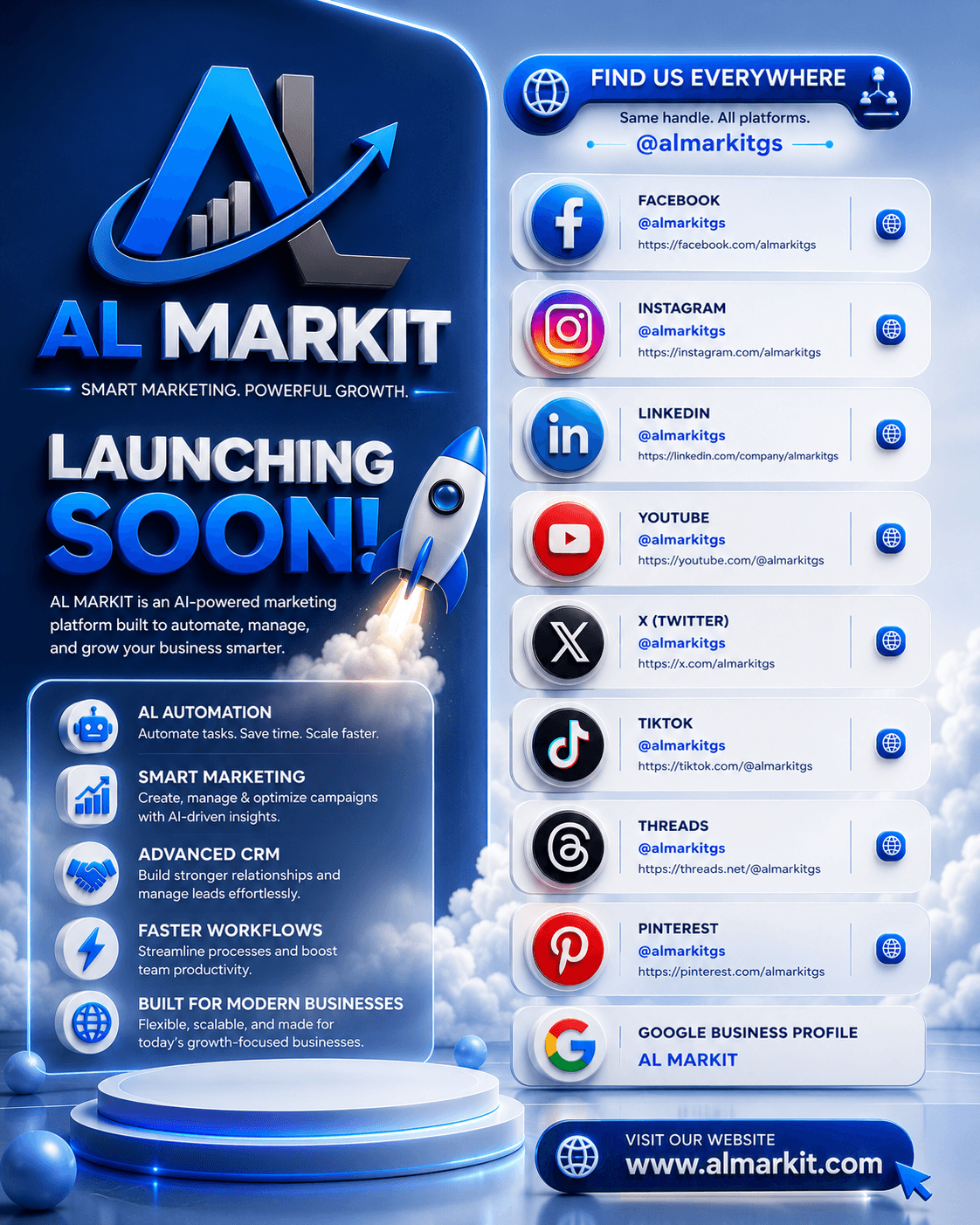
🚀 AL MARKIT Is Launching Soon
🚀 AL MARKIT is launching soon! 🌍✨ Connect with us everywhere using our official handle: **@almarkitgs** ⚡ 📘 Facebook — @almarkitgs 🔗 https://facebook.com/almarkitgs 📸 Instagram — @almarkitgs 🔗 https://instagram.com...
Read Article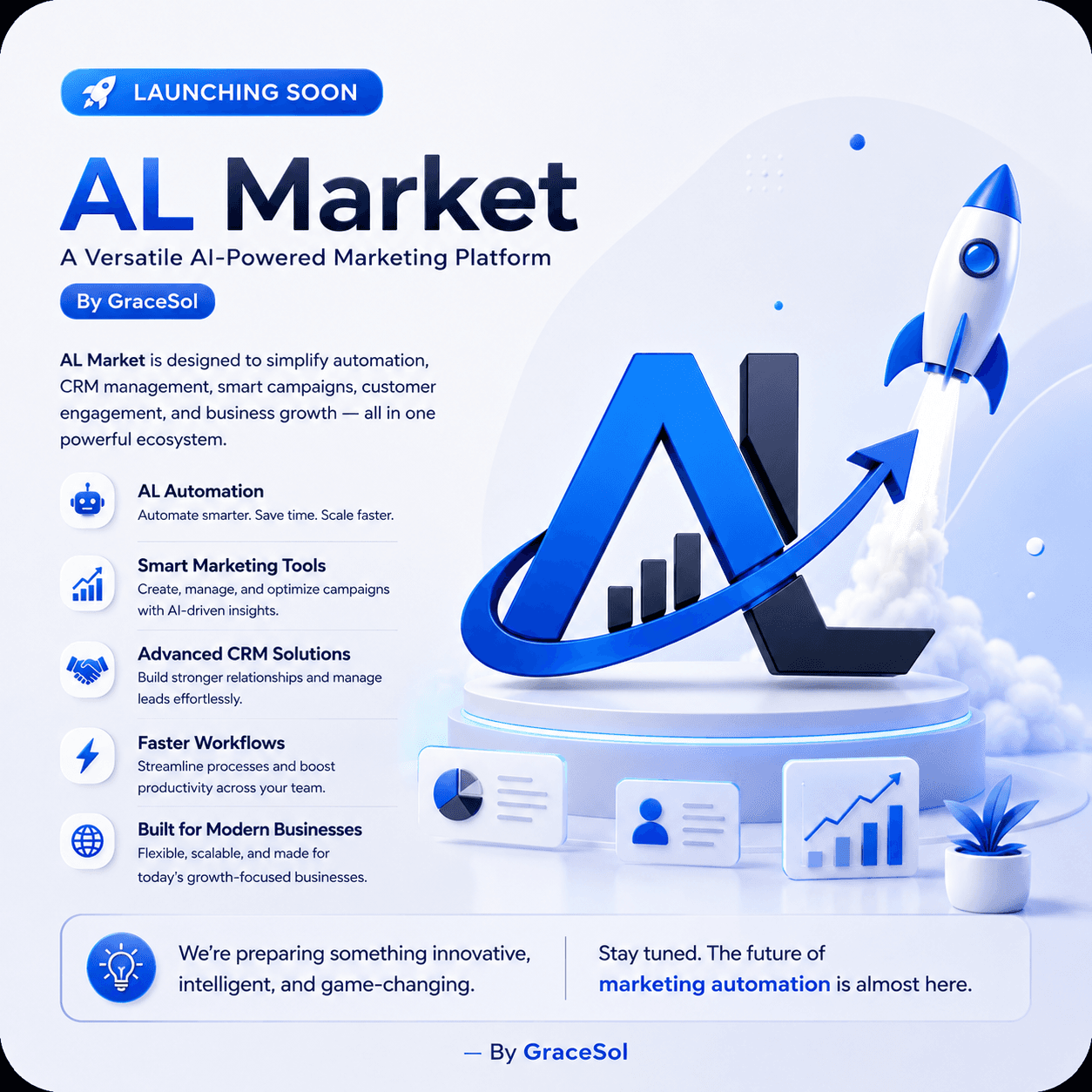
🚀 LAUNCHING SOON Introducing AL Market
🚀 LAUNCHING SOON Introducing AL Market — a versatile AI-powered marketing platform by GraceSol. Designed to simplify automation, CRM management, smart campaigns, customer engagement, and business growth — all in one pow...
Read Article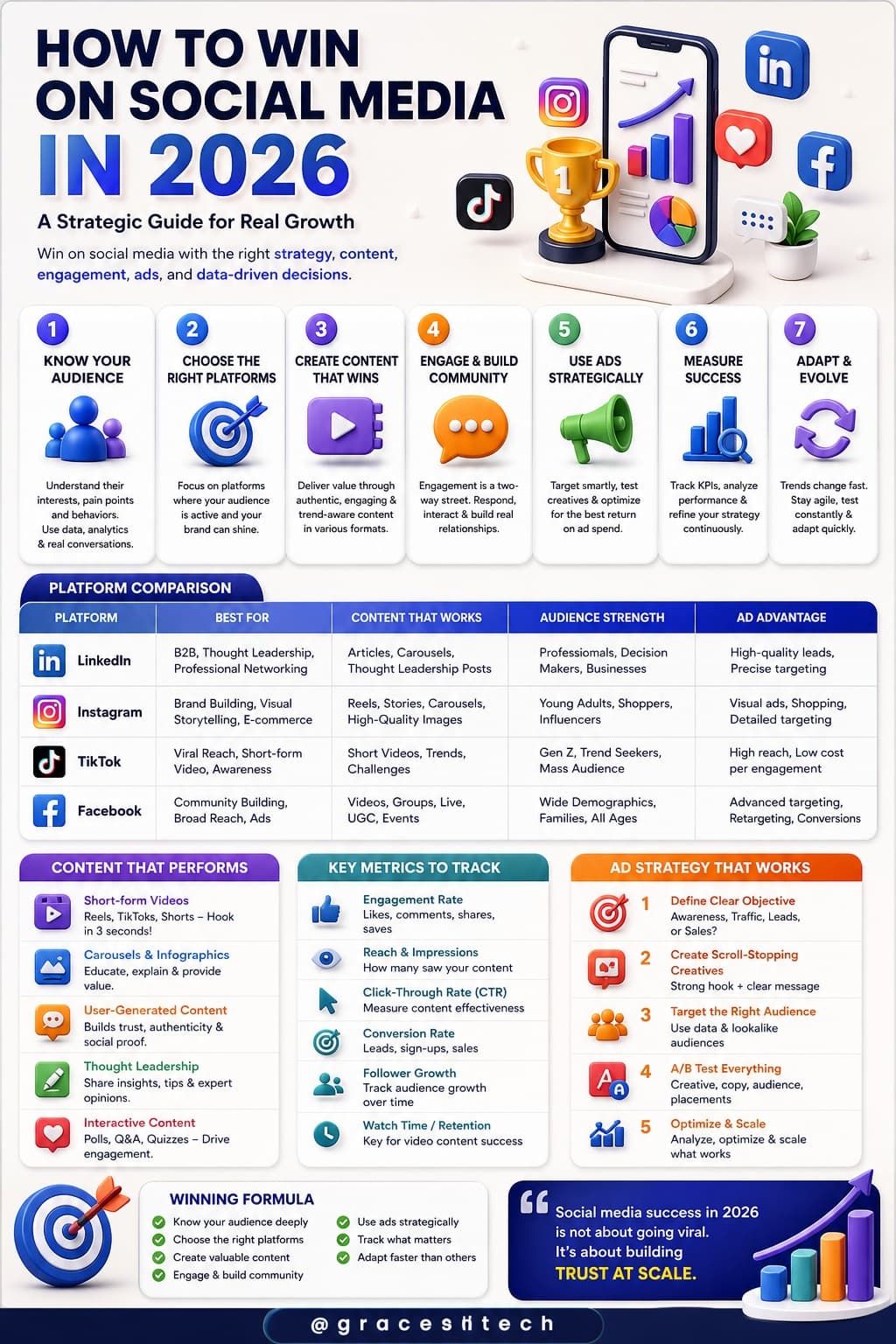
How to Win on Social Media: A Strategic Guide for Growth in 2026
Master the art of social media marketing. Discover actionable strategies for audience engagement, content creation, advertising, and community building to achieve real business growth in 2026.
Read Article