
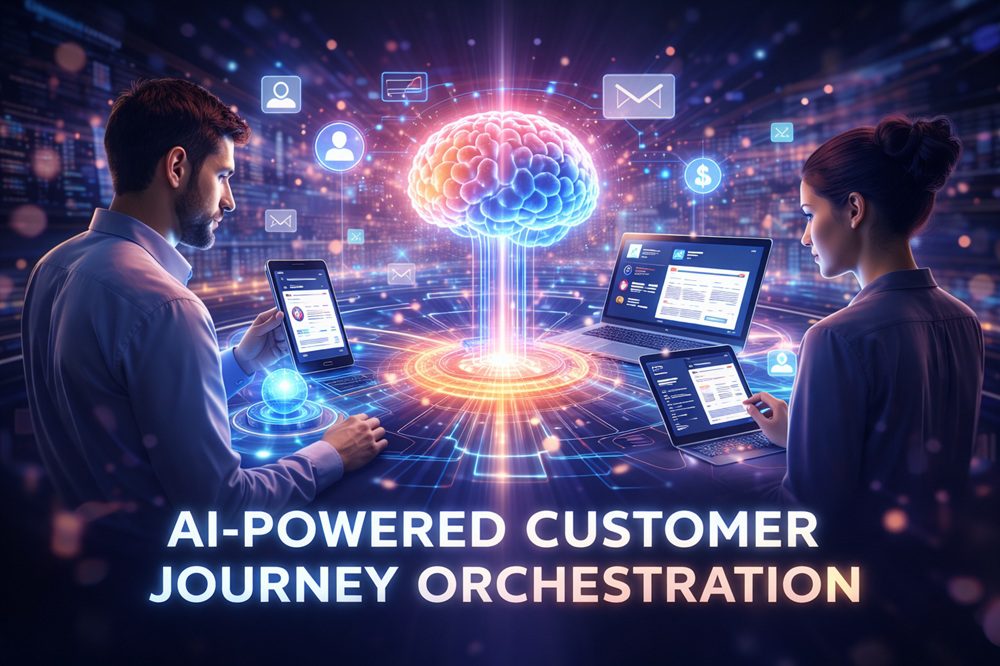
The customer journey is no longer linear. It’s fragmented, algorithm-driven, and happening across dozens of touchpoints simultaneously.
Founders and marketing leaders who still rely on static funnels are watching engagement decline while acquisition costs rise. What’s changed isn’t just channel behavior — it’s customer expectation.
AI-powered customer journey orchestration is redefining how brands predict intent, automate decisions, and deliver hyper-relevant experiences at scale. And the gap between companies using AI intelligently and those not using it at all is widening fast.
Table of Contents
- Why Traditional Journey Mapping Is Failing
- What AI-Powered Journey Orchestration Really Means
- The Business Case: Data & Revenue Impact
- Core Components of AI Journey Orchestration
- Implementation Strategy for SaaS & Digital Brands
- Common Mistakes to Avoid ⚠️
- The Competitive Advantage 🚀
- FAQs
Why Traditional Journey Mapping Is Failing
Legacy journey mapping assumes:
- Predictable stages
- Manual segmentation
- Rule-based triggers
- Fixed customer intent
Modern buyers behave differently:
- They research through AI search engines
- They interact across email, chat, social, and product simultaneously
- They expect personalization in real time
- They shift intent without warning
Static automation can’t respond to that complexity.
What’s required is real-time decision intelligence, not campaign scheduling.
What AI-Powered Journey Orchestration Really Means
AI-powered journey orchestration connects behavioral data, predictive models, and automation engines to dynamically guide each customer through personalized pathways.
It goes beyond marketing automation.
It includes:
- Predictive churn detection
- Next-best-action recommendations
- Behavioral scoring in real time
- Automated content personalization
- Cross-channel optimization
Instead of asking, “Which email should we send?”
The system asks, “What is this specific user most likely to do next?”
That shift changes everything.
The Business Case: Data & Revenue Impact 📊
Organizations investing in AI-driven customer experience consistently outperform peers.
| Metric | Value | Year | Source |
|---|---|---|---|
| Companies using AI in CX reporting revenue growth | 84% | 2023 | Salesforce State of Service |
| Increase in marketing ROI from personalization | 5–8x | 2022 | McKinsey |
| Consumers more likely to purchase from personalized brands | 80% | 2023 | Epsilon |
| Businesses citing AI as critical to CX strategy | 63% | 2024 | Gartner |
Sources:
- https://www.salesforce.com/resources/research-reports/state-of-service/
- https://www.mckinsey.com/capabilities/growth-marketing-and-sales/our-insights/the-value-of-getting-personalization-right-or-wrong-is-multiplying
- https://www.epsilon.com/us/insights/resources/the-power-of-me-report
- https://www.gartner.com/en/articles
The takeaway is clear: AI-driven orchestration directly impacts revenue, retention, and lifetime value.
Core Components of AI Journey Orchestration
1. Unified Data Infrastructure
Without clean, centralized data, orchestration collapses.
This requires:
- CRM integration
- Product analytics
- Behavioral tracking
- First-party data pipelines
AI is only as strong as the data feeding it.
2. Predictive Intelligence 🤖
AI models identify:
- Churn probability
- Upsell readiness
- Content affinity
- Channel preference
This allows proactive engagement instead of reactive marketing.
3. Real-Time Decision Engines
Instead of batch workflows, AI makes decisions in milliseconds:
- Trigger in-app prompts
- Personalize pricing offers
- Adapt onboarding flows
- Change messaging tone
The journey evolves dynamically.
4. Cross-Channel Orchestration
True orchestration spans:
- Paid media
- Website personalization
- Product experience
- Sales engagement
Customers don’t think in channels.
AI shouldn’t either.
Implementation Strategy for SaaS & Digital Brands
Most companies fail because they try to automate everything at once.
A smarter rollout looks like this:
Phase 1: High-Impact Use Case
Start with:
- Onboarding optimization
- Churn prevention
- Expansion triggers
Choose one measurable objective.
Phase 2: Data Consolidation
Align:
- CRM data
- Behavioral analytics
- Support tickets
- Transaction history
If your data isn’t structured, AI won’t create magic.
Phase 3: Deploy Predictive Models
Introduce:
- Churn scoring
- Lead scoring
- Product usage thresholds
Automate interventions based on signals.
Phase 4: Continuous Optimization 🔍
AI orchestration improves through feedback loops:
- A/B testing
- Reinforcement learning
- Conversion data analysis
It’s not a campaign. It’s an evolving system.
Common Mistakes to Avoid ⚠️
1. Treating AI as a tool, not a strategy
AI must align with revenue objectives, not just marketing automation.
2. Ignoring data governance
Privacy regulations and first-party data compliance are non-negotiable.
3. Over-automating early
Too much automation without insight damages customer trust.
4. Forgetting human oversight
AI enhances decision-making — it doesn’t replace leadership judgment.
The Competitive Advantage 🚀
AI-powered customer journey orchestration isn’t optional anymore.
As acquisition costs increase and attention spans shrink, only brands capable of:
- Predicting intent
- Personalizing instantly
- Automating intelligently
- Optimizing continuously
…will maintain profitable growth.
Early adopters gain compound advantage.
Late adopters compete on price.
CTA – In-Content
If your customer lifecycle still runs on static automation, it’s time to rethink the system architecture behind your growth engine.
CTA – Sidebar
Looking to design an AI-driven customer journey strategy tailored to your SaaS or digital platform? Explore how GraceSol helps build scalable orchestration frameworks aligned with measurable revenue goals.
CTA – Exit Intent
Want a clear roadmap for implementing AI-powered journey orchestration inside your business? Request a strategic audit and uncover high-impact automation opportunities.
FAQs
What is AI-powered customer journey orchestration?
AI-powered customer journey orchestration uses predictive analytics and real-time decision engines to guide customers through personalized pathways across channels automatically.
How is it different from marketing automation?
Marketing automation follows predefined workflows.
AI orchestration adapts dynamically based on behavioral data and predictive modeling.
Why is AI important for customer experience?
AI enables real-time personalization, churn prediction, and next-best-action recommendations, improving engagement and retention.
When should a company implement AI orchestration?
When customer data volume increases and manual segmentation becomes inefficient. Typically, this happens once a company scales past early growth stages.
Is AI journey orchestration worth it for SaaS companies?
Yes. SaaS businesses benefit significantly due to recurring revenue models, where retention and expansion are critical to profitability.
Author
GraceSol Team
The GraceSol Team works with founders, SaaS operators, and digital leaders to architect scalable growth systems powered by AI, automation, and data intelligence. With deep experience in digital transformation and performance-driven strategy, the team focuses on building measurable, future-ready growth engines.
Learn more at: https://gracesol.com/about